Something strange is happening to the way people find things online, and most marketers are only just waking up to it.
For twenty-five years, the whole game was Google’s ten blue links. You ranked, you got clicked, you won. Simple. But in 2026, a huge slice of that “discovery” moment now happens inside an AI answer — before anyone scrolls, before anyone clicks, often before anyone even visits a website. Someone asks ChatGPT which CRM to buy, Gemini summarizes the five best ones, and the decision gets shaped right there in the chat window.
That shift has a name now: Generative Engine Optimization, or GEO. It’s the practice of getting your content retrieved, trusted, and cited by AI engines like ChatGPT, Gemini, Perplexity, Copilot, and Google’s AI Overviews.
And the data behind it has gotten genuinely wild. AI-referred traffic is up 527% year over year. The old “rank in the top 10 and you’ll get cited” rule has quietly fallen apart. Comparison articles are eating a third of all citations. And the US GEO market alone is on track to hit $365.4 million this year.
Let’s get into the numbers — and more importantly, what they actually mean for you.
The big one: AI-referred sessions jumped 527% in a single year
If you only remember one stat from this article, make it this one.
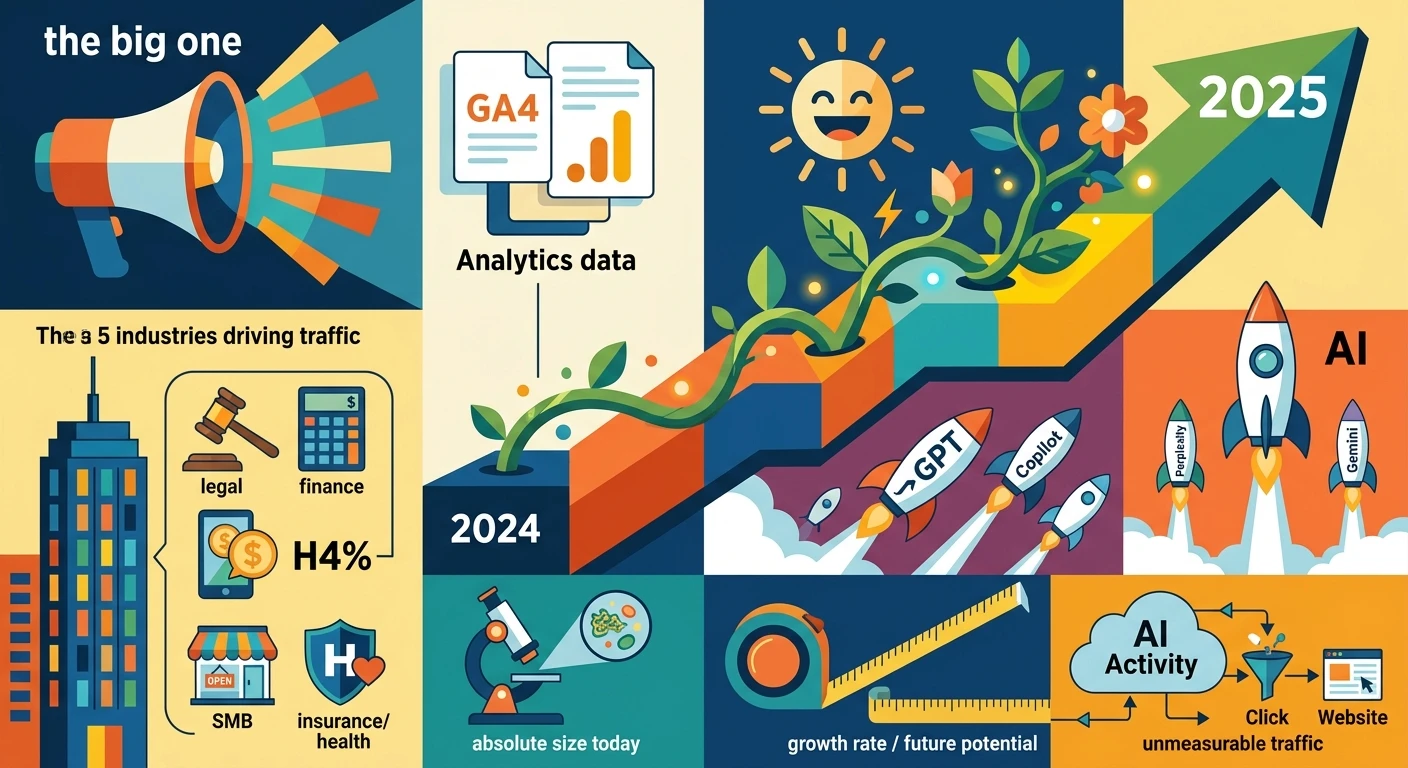
According to Previsible’s 2025 AI Traffic Report (analyzed by Search Engine Land), total AI-referred sessions across nineteen GA4 properties climbed from 17,076 to 107,100 when you compare the first five months of 2025 against the same window in 2024. That’s a 527% year-over-year increase.
Now, I want to be straight with you about what that number is. It’s not a measure of the entire internet — it’s nineteen specific analytics properties. But the shape of the growth is the whole story. In one standout property in that study, ChatGPT referrals went from about 600 visits a month in early 2024 to over 22,000 a month by May 2025. That’s not a trend line. That’s a channel being born in front of your eyes.
If you’ve been in marketing long enough, this should feel familiar. It’s the same energy as the mobile-first shift in the early 2010s, or the moment social media stopped being a “nice to have” and became a real acquisition engine. Every time the rules changed like this, the early movers cleaned up. This time it’s just happening faster.
A few supporting numbers worth knowing:
Five industries drive over half of all AI traffic. Legal, Finance, SMB, Insurance, and Health together account for 55% of all LLM-driven sessions in the dataset. People aren’t using AI like a search box — they’re asking it the consultative, high-trust questions they’d normally ask an expert.
ChatGPT dominates, but it’s no longer alone. ChatGPT typically drives 40–60%+ of LLM traffic in any vertical, but Perplexity, Copilot, and Gemini are all carving out real, measurable share.
It’s still small in absolute terms. AI referrals average around 1% of total sessions even on the most developed sites. The point isn’t the size today — it’s the growth rate and, as you’ll see in a second, the enormous volume of AI activity that never shows up as a click at all.
Here’s a quick snapshot of how AI penetration grew by industry over that period:
Industry | AI Share (Early Period) | AI Share (Recent) | Direction |
Legal | 0.37% | 0.86% | ↑ Sharp rise |
Health | 0.17% | 0.56% | ↑ Sharp rise |
Finance | Climbing | 1%+ in some domains | ↑ Strong |
SaaS | Climbing | 1%+ in select domains | ↑ Breakout cases |
The pattern is obvious: the more complex and trust-heavy the decision, the more people are leaning on AI to help them make it.
The citation earthquake: 83% of AI Overview citations now come from outside the top 10
Okay, this is the part that’s keeping SEO directors up at night.
For years, the deal was simple: rank in Google’s top 10, and you had a real shot at being pulled into the AI answer. That deal is dead.
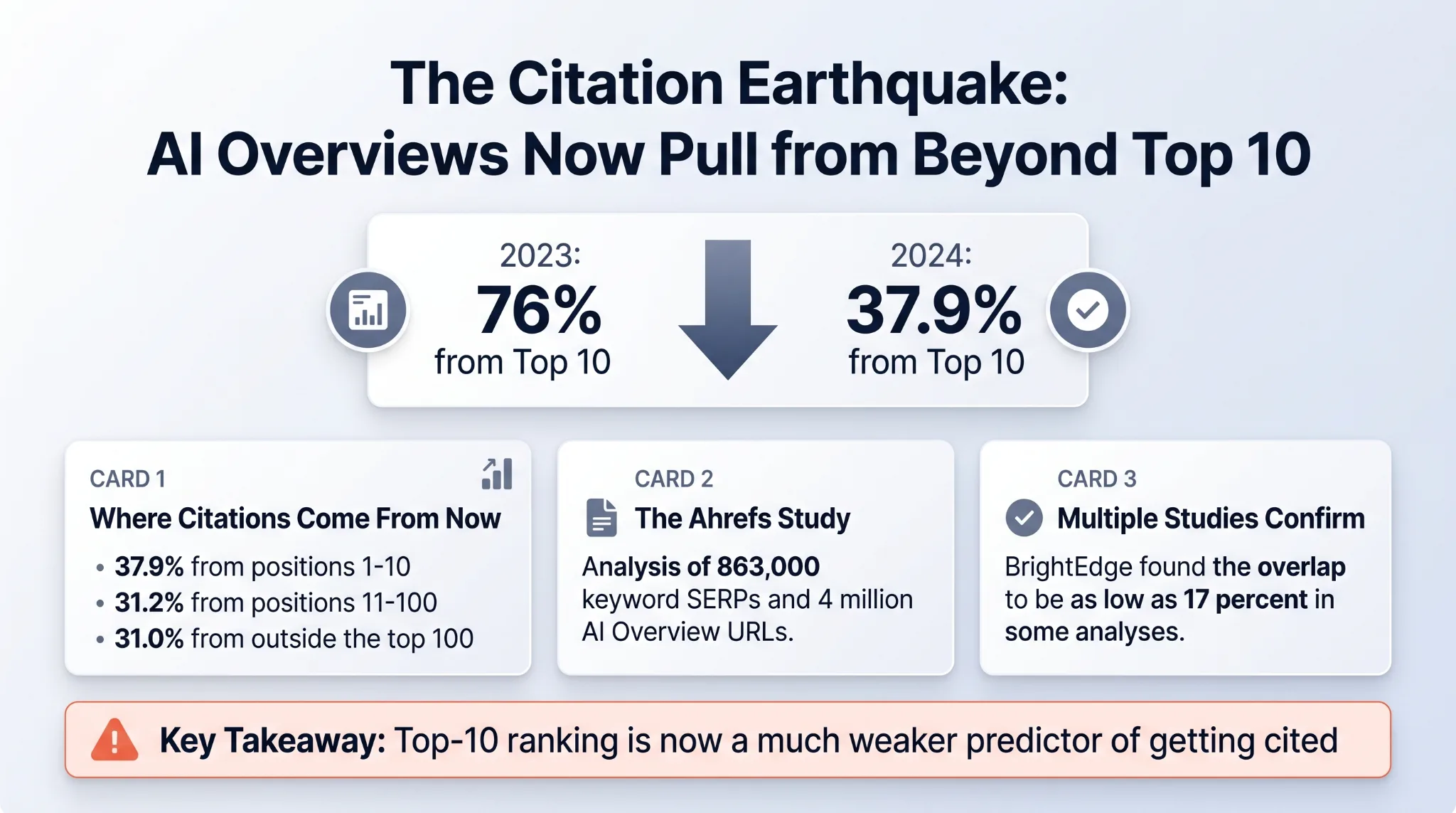
Ahrefs ran the definitive study here. They analyzed 863,000 keyword SERPs and roughly 4 million AI Overview URLs — more than double their previous research. The finding landed like a brick:
Only 37.9% of URLs cited in AI Overviews also ranked in the top 10 for that same query.
The other ~62% split almost evenly between positions 11–100 (31.2%) and pages that didn’t rank in the top 100 at all (31.0%). And here’s the kicker — just a year earlier, that top-10 overlap was around 76%. So in twelve months, the share of citations coming from outside the top 10 roughly doubled.
You’ll see a few different versions of this stat floating around — “83% from outside the top 10,” “62%,” “only 17% overlap.” They’re not contradicting each other; they’re just different studies slicing the same phenomenon with different definitions. BrightEdge, for example, found AI Overview overlap with the organic top 10 sitting as low as ~17% in some cuts. The exact percentage shifts depending on how you define “citation” and “ranking” and which queries you sample.
But every single study agrees on the direction: top-10 ranking is now a much weaker predictor of getting cited than it used to be.
Why did this happen? Two words: query fan-out
This is the mechanism behind the whole thing, and it’s worth understanding.
When you ask an AI-powered search a question, Google doesn’t just look up your exact query. It quietly breaks your question into a bunch of related sub-questions, runs all of them, and then builds its answer by pulling citations from the pages that keep showing up across that whole expanded set. Google has officially confirmed this “query fan-out” technique.
And since AI Overviews started running on Gemini 3 as of January 2026, that fan-out seems to be casting an even wider net — pulling from related SERPs where the “obvious” pages don’t necessarily rank.
The practical takeaway is a little mind-bending: you can win a citation for a sub-query you never knew existed, and lose one even while you’re sitting at #1 for the main keyword.
Some data that makes fan-out concrete (from AirOps):
Fan-out behavior shows up in 89.6% of ChatGPT prompts.
About 32.9% of all cited pages were found only through these follow-up searches — not the original query.
The #1 page on a supporting query can grab 35–40% of citations.
The top three supporting pages together can claim 75–85% of citations.
Translation: a handful of well-targeted support pages can quietly influence way more AI demand than their traffic numbers would ever suggest. That’s an unusually efficient place to put your effort.
The YouTube surprise
Here’s a detail that catches most people off guard: YouTube is now the single most-cited domain in AI Overviews, and it’s grown 34% in six months (per Ahrefs Brand Radar).
Among AI-cited pages that didn’t even rank in Google’s top 100 for the query, 18.2% were YouTube URLs. And separate Ahrefs research across 75,000 brands found that mentions on YouTube — in titles, descriptions, and transcripts — were the single strongest correlating factor with AI visibility.
If video isn’t part of your GEO plan, that’s a gap worth closing.
What actually gets cited: comparison articles, clean structure, and a brutal 15% rule
Knowing citations are up for grabs is nice. Knowing what wins them is where the money is.
The headline content stat: 32.5% of AI citations come from comparison articles — your classic “X vs Y” pieces and original head-to-head analysis.
This makes total sense when you think about how people actually use AI. They’re at the decision stage. “Which one should I pick?” When a model is helping someone choose, the content that directly compares the options is the most useful and the most extractable — so it gets pulled disproportionately. Real, original comparison wins. Thin aggregation does not.
But here’s the harsh reality check. Being retrieved is not the same as being cited:
AirOps found that ChatGPT only cites about 15% of the pages it actually retrieves. The other 85% get read and tossed.
That one number reframes the entire problem. The job isn’t just to be findable. It’s to be selectable — to answer the exact sub-question cleanly, back it with evidence, and format it so the model can lift it word-for-word.
So what makes a page selectable? The research is refreshingly specific:
Content Trait | Citation Impact |
Clear heading hierarchy | Used by 68.7% of cited pages |
Short “answer capsules” (20–25 words under a question heading) | Used by 72.4% of cited posts |
Author / person schema | 67% lift in citations |
Schema aligned with heading structure | 2.8x citation lift |
Comparison / original analysis format | 32.5% of all citations |
And here’s the most encouraging finding for anyone without a giant content budget: the AgentGEO research achieved a 40%+ relative improvement in citation rate while modifying only 5% of a site’s content. Small, surgical edits aimed at extractability beat expensive full-site rewrites.
One more theme that runs through all of this: AI engines check your authority off-site as much as on-site. Third-party domains — Wikipedia, Reddit, forums, review sites, trade press — often win more citations than a brand’s own pages, because models use outside sources to corroborate that you’re legit. GEO is as much a digital-PR and reputation game as it is an on-page one. You can’t just optimize your own website into citations.
The zero-click problem nobody wants to talk about
Here’s the uncomfortable truth sitting underneath all of this:
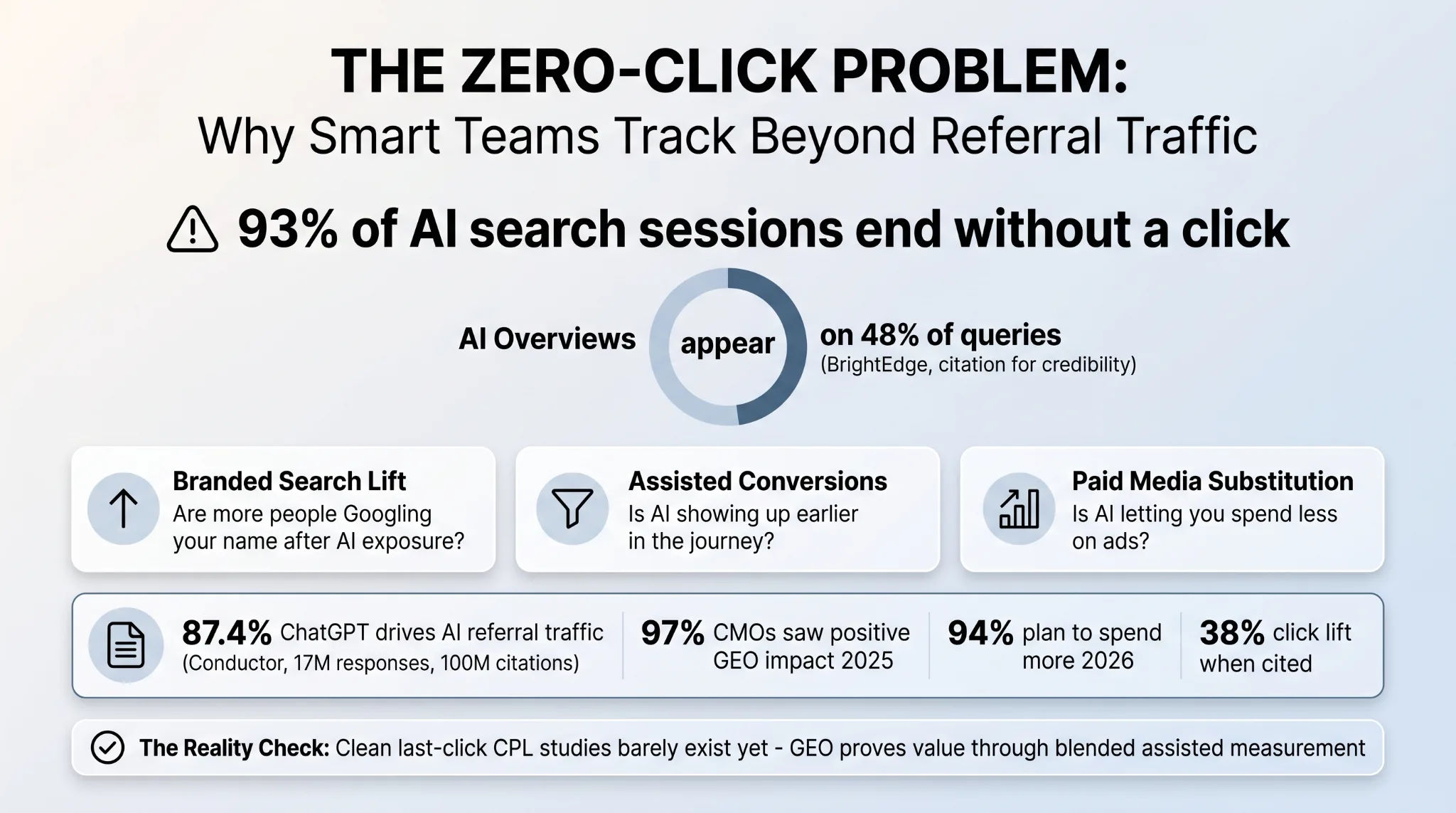
Roughly 93% of AI search sessions end without a click to any website.
And AI Overviews now appear on around 48% of tracked queries (per BrightEdge). So nearly half of all category research can happen entirely inside an AI answer. The user gets what they need, your brand may have completely shaped that answer, and yet… no referral session ever gets recorded in your analytics.
This is exactly why the smartest GEO teams have stopped obsessing over referral traffic as their main metric. Instead they’re tracking assisted signals:
Branded search lift — are more people Googling your name after AI exposure?
Assisted conversions — is AI showing up earlier in the journey?
Paid media substitution — is AI visibility letting you spend less on ads to capture the same demand?
The business case is building. Conductor’s benchmark — based on a genuinely massive sample of 17 million AI responses, 100 million citations, and 3.3 billion sessions — found ChatGPT driving about 87.4% of measured AI referral traffic (a clear place to start your tracking). Conductor also reported that 97% of CMOs saw positive GEO impact in 2025, and 94% plan to spend more on it in 2026. And cited brands have seen roughly a 38% click lift when they do appear as a source.
The honest caveat: clean, last-click CPL studies for GEO barely exist yet. The discipline is still proving its economics through blended, assisted measurement rather than tidy attribution. So if someone’s promising you guaranteed CPL reduction from GEO, they’re running ahead of the actual data.
Follow the money: the $365.4M US market heading toward $17 billion
The clearest sign GEO has gone from science experiment to real category? The budgets.
Dimension Market Research projects the US GEO market at $365.4 million in 2026, growing at a 42.9% CAGR to roughly $6.36 billion by 2034. Globally, they size it at $1.09 billion in 2026, scaling to $17.1 billion by 2034 at a 40.6% CAGR.
Here’s the global outlook at a glance:
Region | 2026 Market Size | 2034 Projection | CAGR |
Global | $1,089.3M | $17,148.6M | 40.6% |
United States | $365.4M | $6,359.6M | 42.9% |
Europe | $243.8M | $2,775.1M | 35.5% |
Japan | $45.1M | $390.9M | 31.0% |
Asia-Pacific | (fastest growing) | — | 45.1% |
Other analysts model it differently — Valuates pegs GEO services at $886M in 2024 heading to $7.3B by 2031 — but every forecast lands on the same conclusion: a category compounding somewhere in the 34–45% range every year. Honestly, the disagreement between analysts is itself a tell. This is a young, fast-moving market that the data world is still figuring out how to measure, exactly like “SEO” in its early days.
A couple of structural notes worth knowing:
Software dominates spending (~79%), led by analytics, monitoring, and AI-visibility platforms. Managed services and consulting are the fastest-growing slice, because demand for GEO expertise is wildly outpacing supply.
Retail and eCommerce is the biggest end-user vertical, with software and technology right behind.
Nearly half the market hasn’t moved yet. A HubSpot survey found 47% of brands still have no GEO strategy at all.
That last stat is the opportunity in a nutshell. Big market, growing fast, and still mostly unclaimed.
So what do you actually do with all this?
Let me boil the whole thing down, because it’s easy to drown in percentages.
The picture is surprisingly coherent once you step back:
A new discovery channel grew 527% in a year, and it’s concentrated in the exact high-trust verticals where real buying decisions get made.
The old “rank top 10, get cited” rule is broken. The majority of AI citations now come from outside the traditional first page, thanks to query fan-out.
The content that wins is comparison-driven, cleanly structured, schema-supported, and corroborated off-site — but only ~15% of retrieved pages ever make the cut.
About 93% of AI interactions are zero-click, so you have to measure assisted impact, not just referral traffic.
There’s $365.4 million flowing into the US market this year alone — and half your competitors haven’t started.
And here’s the takeaway I’d leave you with: this isn’t “abandon SEO.” Strong organic foundations still correlate with citation, and search is splitting into two tracks rather than dying. What’s changed is the definition of winning. Visibility used to mean ranking near the top. Now it means being the source the AI chooses to quote.
The brands that internalize that difference now — while 47% of the market is still standing on the sidelines — are the ones who’ll own this channel when it grows up. And based on these numbers, it’s growing up fast.
A quick note on the data: the headline stats here come from primary research by Previsible/Search Engine Land (the 527% figure), Ahrefs (citation and ranking overlap), AirOps and Conductor (retrieval, fan-out, and CMO data), BrightEdge (AI Overview presence), and Dimension Market Research (market sizing). Because different studies define “citation,” “ranking,” and “AI session” differently, you’ll see ranges rather than one agreed number — the overall direction is far more reliable than any single percentage, so treat each specific figure as study-dependent rather than gospel.
also conclusion needs to he there and check the competitord snd aldo write 4-05 faq and chck for AI optimsiedation so tha tAI citation we can get
I’ll research how competitors structure these GEO articles and what FAQs rank, then optimize the conclusion and add an AI-citation-friendly FAQ section.
Using Tool
|
Parallel Search
GEO statistics 2026 article FAQ what is generative engine optimization
how to get cited by AI ChatGPT GEO best practices 2026
generative engine optimization vs SEO difference FAQ
View
I have what I need. Here’s the updated FAQ section and a proper conclusion, both written to be AI-citation-friendly (direct answer capsules, clear question headings, fact density). You can append these to the end of the article.
Conclusion: GEO Is No Longer Optional — and the Window Is Open Now
Step back from the individual percentages and the 2026 picture is remarkably clear. A brand-new discovery channel has exploded 527% in a single year, and it’s concentrated in exactly the high-trust industries — legal, finance, health, insurance — where real buying decisions get made. The comfortable old rule that ranking in Google’s top 10 guarantees AI visibility has collapsed, with the majority of citations now pulled from outside the first page through query fan-out. The content that wins is comparison-driven, cleanly structured, schema-supported, and backed by off-site authority — yet only about 15% of the pages an AI retrieves ever make it into the final answer.
At the same time, roughly 93% of AI interactions are zero-click, which means the brands still measuring success purely by referral traffic are flying blind. And there’s serious money confirming this is real: $365.4 million flowing into the US market this year alone, on a path toward a $17 billion global market by 2034.
But here’s the part that should actually motivate you. Nearly half of all brands — 47% — still have no GEO strategy at all. That’s not a warning. That’s an opening.
The shift in mindset is the whole game. SEO isn’t dying; it’s splitting into two tracks, and traditional rankings still feed AI citations. What’s changed is the definition of winning. Visibility used to mean ranking near the top of a list. In 2026, it means being the source the AI chooses to quote — being understood, selected, and cited. The companies that internalize that difference while their competitors hesitate are the ones who’ll own this channel when it matures.
And based on every number in this article, it’s maturing faster than anyone expected. The brands that move now — auditing their AI citations, building comparison content, structuring pages for extractability, and tracking assisted impact — won’t just keep up. They’ll define what visibility looks like for the next decade of search.
The question isn’t whether AI will reshape how customers find you. The data says it already has. The only real question is whether your content will be in the answer — or watching from outside it.
FAQs
Generative Engine Optimization (GEO) is the practice of structuring content so AI engines like ChatGPT, Gemini, and Perplexity retrieve, trust, and cite it inside their generated answers. Unlike traditional SEO, which targets a ranked link, GEO aims to make your content the source an AI quotes when responding to a user's question.
AI-referred traffic has grown 527% year over year, with AI-driven sessions rising from 17,076 to 107,100 across the first five months of 2025 compared to the same period in 2024. ChatGPT alone drives roughly 40–60% of AI referral traffic in most verticals, though Perplexity, Gemini, and Copilot are rapidly gaining share.
No — only 37.9% of AI Overview citations also rank in the organic top 10, meaning roughly 62% of citations come from pages outside that traditional threshold. Google's query fan-out technique breaks questions into sub-queries and cites pages that answer them well, regardless of their original keyword ranking.
Comparison articles are cited most frequently, accounting for 32.5% of all AI citations, because AI engines often answer decision-stage questions using clear "X vs Y" analysis. Pages with structured heading hierarchies, short 20–25 word answer capsules under question headings, and author schema also show significantly higher citation rates.
The global GEO market is valued at $1.09 billion in 2026 and is projected to reach $17.1 billion by 2034 at a 40.6% CAGR. Despite this rapid growth, 47% of brands currently have no GEO strategy in place, representing a significant competitive opportunity for early adopters.