You read a headline that says Grok has 550 million users. You read another that says 35 million. Both ran the same week, both sound confident, and both are technically defensible. That gap is the whole problem with Grok AI statistics in 2026. The numbers are real, but they measure different things, and almost nobody tells you which.
I have tracked Grok since it was a beta locked inside X, and the climb has been the steepest I have watched in AI. It also got messy fast, with a model line that reached Grok 4.3, a third-place finish in the US chatbot race, and a February merger that folded the whole company into SpaceX. This piece lays out the Grok AI statistics that actually hold up, names the source and date on each one, and tells you plainly where the trackers disagree.
💡 Quick Tip: Before you trust any Grok user number, check whether it counts the standalone Grok app or bundles in X. The two differ by hundreds of millions. Most viral stat posts blur the line on purpose, because the bigger number gets more clicks.
Grok vs the Other Top AI Chatbots
Here is the fast reference before the deep dive. This is where Grok sits against the two players ahead of it, based on US market data from Reuters citing Apptopia, January 2026.
Chatbot | Key Edge | Best For |
ChatGPT | Largest reach, ~52.9% US share | General use, the default assistant |
Gemini | Deep Google and Android integration, ~29.4% US share | Search, Workspace, Pixel and now Siri |
Grok | Real-time X data, fastest climber, ~17.8% US share | Live news, X users, unfiltered answers |
Grok is third. That is not a knock. A year earlier its US share sat near 1.9%, so third place is the result of close to a ninefold jump in twelve months.
How Many People Actually Use Grok?
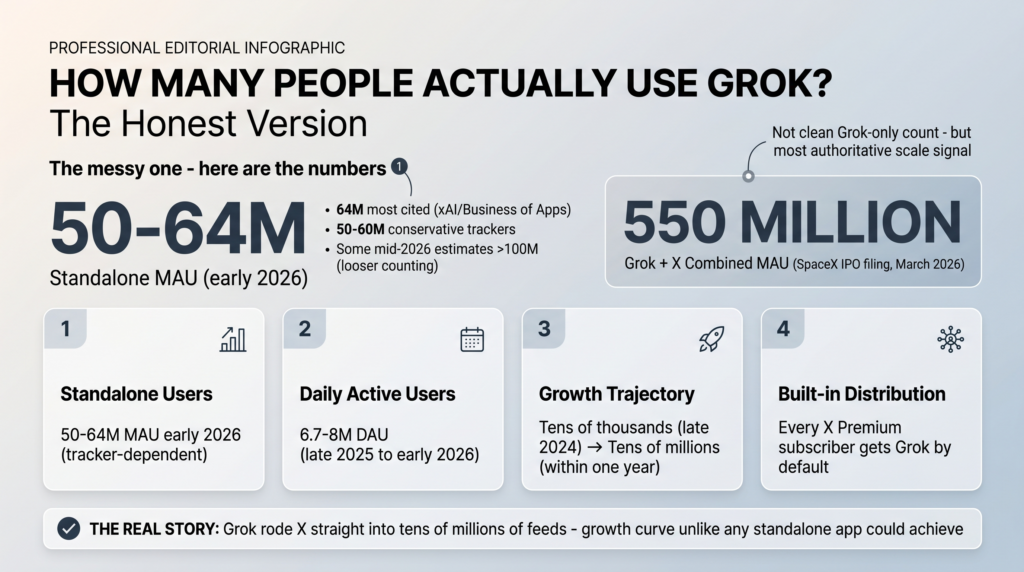
This is the messy one, so here is the honest version. Grok’s standalone monthly active users land somewhere between 50 and 64 million in early 2026. The 64 million figure, tied to xAI’s own reporting through Business of Apps, is the most cited. More conservative trackers say 50 to 60 million. A few mid-2026 estimates run higher, above 100 million, using looser counting.
The biggest official number comes from SpaceX’s IPO filing, which reported about 550 million monthly active users for Grok and X combined as of March 31, 2026. That is the chatbot plus the social platform it lives inside, so it is not a clean Grok-only count. It is still the most authoritative scale signal on the table.
Grok User Highlights
Standalone MAU: roughly 50 to 64 million, early 2026, depending on the tracker
Combined Grok and X MAU: about 550 million, per SpaceX’s filing, March 2026
Daily active users: around 6.7 to 8 million, late 2025 into early 2026
Growth curve: from tens of thousands of users in late 2024 to tens of millions within a year
Built-in distribution: every X Premium subscriber gets Grok by default
The distribution point is the real story. Grok did not have to win users one by one. It rode X straight into tens of millions of feeds, which is why its growth curve looks unlike anything a standalone app could pull off.
What You Pay for Grok
Grok runs a free tier with rate limits, then charges for the heavier stuff. The numbers as of mid-2026:
Free tier: limited daily usage, enough to test the model
SuperGrok: about $30 per month for higher limits and the newest models
X Premium bundle: Grok access is included with paid X subscriptions
Grok 4 Fast API: roughly $0.20 per million input tokens and $0.50 per million output tokens
Government pricing: Grok 4 and Grok 4 Fast offered to US federal agencies at $0.42 per agency for 18 months
That $0.42 government rate is not a typo. xAI is buying its way into the public sector at a price designed to lock in agencies before rivals do.
Grok Web Traffic and Engagement
Web traffic gives a cleaner month-to-month read than user counts. Per Similarweb, grok.com moved like this:
Month | Monthly Visits | Note |
November 2025 | ~234 million | Steady climb |
January 2026 | ~314 million | More than doubled in five months |
March 2026 | ~326 million | Peak to date |
May 2026 | ~244.8 million | Down about 12% from the prior month |
The dip in raw visits is not the full picture. Similarweb pegged the average visit at about 11 minutes, with roughly 12.9 pages per visit and a 31% bounce rate, and ranked grok.com the fourth most visited AI chatbot site in the US. People who land on Grok stick around, which matters more than a single month of traffic noise.
Who Uses Grok? Demographics and Geography
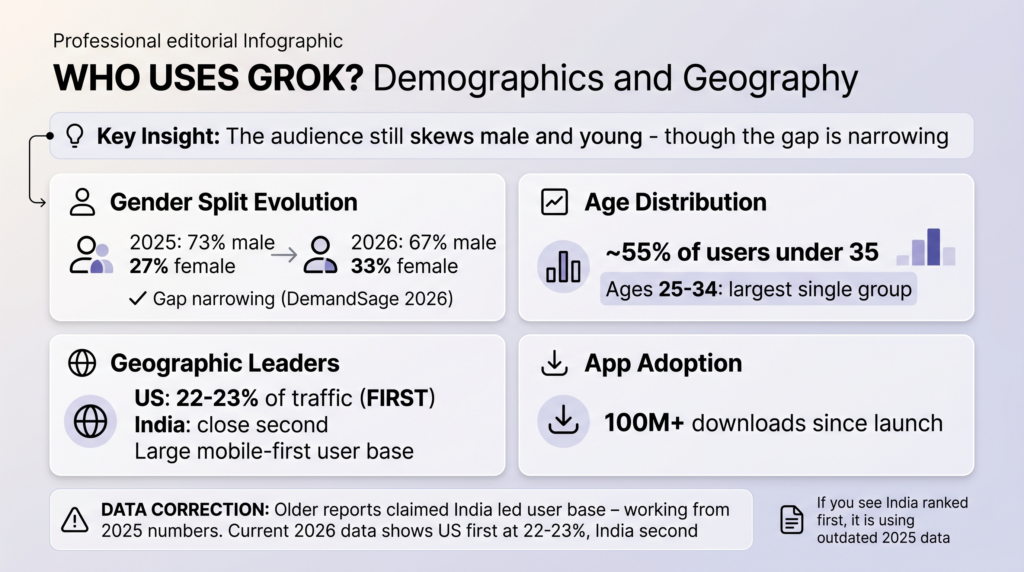
The audience still skews male and young, though the gap is narrowing.
Grok Audience Highlights
Gender: about 67% male and 33% female, per DemandSage’s 2026 update, down from a wider 73 to 27 split in 2025
Age: roughly 55% of users are under 35, with 25 to 34 the largest single group
Top country: the United States, at about 22 to 23% of traffic
Strong second: India, with a large, mobile-first user base
App downloads: more than 100 million since launch
Note the correction here. Older write-ups claimed India led Grok’s user base. Current data puts the US first at about 22 to 23%, with India a close second. If you see India ranked first, it is working from 2025 numbers.
The Grok Model Timeline
xAI ships models faster than almost anyone. The line so far:
Grok-1 (November 2023): first release, made open source in March 2024
Grok-2 (August 2024): went multimodal with image understanding and generation
Grok-3 (February 2025): the breakout, trained on far more compute, drove the first user surge
Grok-4 (July 2025): a major reasoning step, later joined by a faster Grok 4 Fast
Grok 4.1: rolled out to all users
Grok 4.3 Beta (April 2026): the latest public iteration
On benchmarks, Grok 4 scored about 91.7% on the AIME 2025 mathematics test, per SQ Magazine, and led several reasoning evaluations at launch. One honest caveat. xAI has not published official parameter counts for its recent models, so any exact parameter figure you see floating around is an estimate, not a confirmed spec.
The Business Behind Grok: xAI, Funding, and the SpaceX Merger
This is now the headline, not a footnote. The chain of events:
March 2025: xAI acquired X in an all-stock deal, folding the social platform into the AI company
January 2026: xAI closed a roughly $20 billion Series E at a reported $230 billion valuation, pushing total funding past $40 billion
February 2, 2026: SpaceX acquired xAI in an all-stock deal, valuing xAI near $250 billion inside a combined entity worth about $1.25 trillion
June 2026: SpaceX filed to go public on Nasdaq under the ticker SPCX, with valuation targets reported as high as $1.5 to $1.75 trillion
The money math is brutal and worth stating plainly. SpaceX’s IPO filing showed xAI with about $3.2 billion in 2025 revenue against a $6.4 billion operating loss. Grok is a money-loser for now. The long bet is on owning cheap AI compute, first through the Colossus supercomputers in Memphis and Mississippi, and eventually in orbit through SpaceX’s satellite plans.
Grok Pros and Cons
Pros
Real-time access to X data, which no major rival matches
Fastest growth curve in the chatbot race, third in the US in twelve months
Strong reasoning scores, including about 91.7% on AIME 2025
Built-in distribution through X and now SpaceX-scale capital
Cons
Deep losses, $6.4 billion in 2025, with more spending ahead
User numbers are murky and easy to overstate by blending Grok with X
Regulatory heat, with UK and EU probes into Grok’s image-generation tools in early 2026
🎯 Why Grok matters: No AI product has gone from beta to a $250 billion subsidiary of a $1.25 trillion company this fast. The numbers are inflated by X distribution and dragged down by heavy losses, but the trajectory is real. Grok is third in the US chatbot race and backed by more capital than almost any competitor.
FAQs
Grok's standalone monthly active users are estimated at roughly 50 to 64 million in early 2026. When combined with X platform users, SpaceX's IPO filing reported approximately 550 million monthly active users as of March 2026.
Grok holds about 17.8% of the US consumer chatbot market as of January 2026, placing it third behind ChatGPT at 52.9% and Gemini at 29.4%, according to Reuters citing Apptopia data.
No, xAI is no longer independent. SpaceX acquired xAI on February 2, 2026, valuing the combined entity at nearly $1.25 trillion, and since xAI had previously acquired X in March 2025, both Grok and X now operate under SpaceX.
Grok offers a free tier with usage limits, while the SuperGrok subscription costs around $30 per month and is also bundled with X Premium. Developers accessing the API pay approximately $0.20 per million input tokens and $0.50 per million output tokens for Grok 4 Fast.
Despite generating roughly $3.2 billion in 2025 revenue, xAI reported a $6.4 billion operating loss, reflecting the enormous infrastructure and development costs required to compete at the frontier of AI.