If you have been watching the AI industry from any corner of the internet, you already know that the last twelve months have redrawn the competitive map in ways few analysts predicted. For the longest time, the narrative was settled: ChatGPT led, Google Gemini competed hard, and Claude was the beloved, capable underdog that power users swore by but most people had never actually opened. That story no longer reflects reality. In 2026, Claude has undergone a transformation so rapid and so dramatic that even industry insiders have described it as “a step function, not a trend line.” This article breaks down every major Claude statistic that matters — from raw user numbers and explosive revenue data, to the full model family breakdown and everything content creators need to understand to use Claude effectively this year.
The Big Picture: What Has Changed in 2026
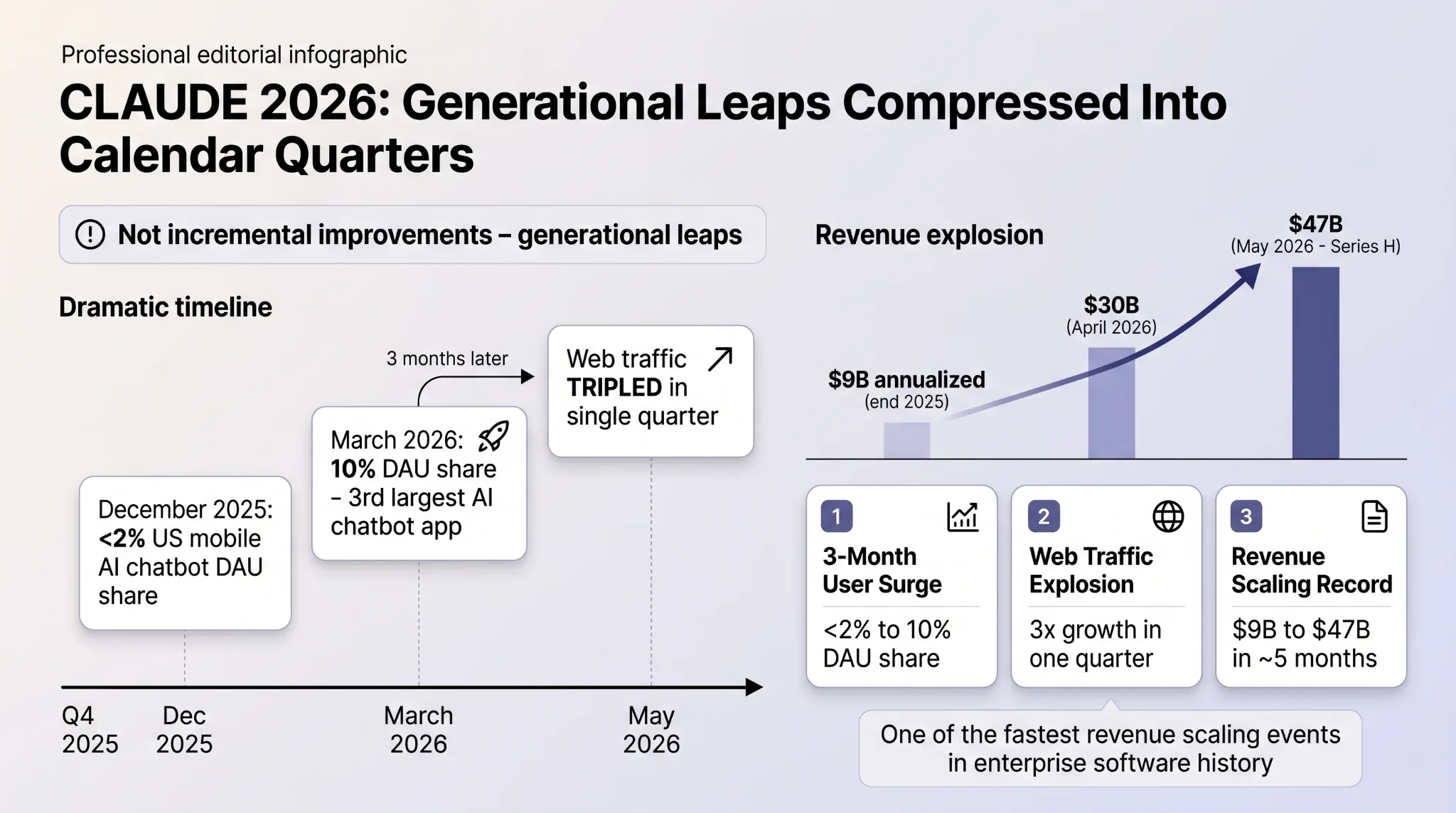
To understand where Claude stands today, you first need to appreciate the velocity of change. As recently as December 2025, Claude held less than 2% of the U.S. mobile AI chatbot daily active user share. By March 2026 — a mere three months later — that figure had risen to 10%, making Claude the third-largest AI chatbot app in America by daily active users. Its web traffic tripled in a single quarter. Anthropic’s annualized revenue went from roughly $9 billion at the end of 2025 to over $30 billion by April 2026, and then — in a development that sent the entire tech world spinning — all the way to $47 billion by late May 2026 when the company closed its historic Series H funding round.
These are not incremental improvements. These are generational leaps compressed into calendar quarters, and they represent one of the fastest revenue scaling events in the history of enterprise software.
Claude AI User Statistics 2026
Monthly Active Users and Total Reach
The headline consumer figure for Claude stands at approximately 30 million monthly active users as of mid-2026, up from 18.9 million at the start of the year. That 18.9 million figure was itself a significant milestone — representing a journey from just 4 million monthly active users in December 2023 to nearly 19 million by early 2026. However, the 30 million figure is conservative because it only captures direct consumer usage through Claude.ai. When you add enterprise API users, developers building on Claude through AWS Bedrock, Google Cloud Vertex AI, and Microsoft Azure Foundry, plus the indirect reach through the 6,000+ enterprise applications natively integrated with Claude (including Salesforce, Notion, and Slack), total estimated reach climbs into the hundreds of millions of users worldwide.
The mobile app tells its own remarkable story. Claude’s iOS app launched in May 2024, followed by Android in July 2024. By January 2025, the app had 2.9 million monthly active users. By early 2026, that figure had risen to approximately 7.38 million monthly active app users — a more than 2.5x increase in twelve months. Then came March 2026, when the app downloaded 7.4 million times in a single month — nearly triple its February total, and more than 14 times what it was pulling in September 2025. On February 28, 2026, the Claude iOS app hit #1 overall in the U.S. App Store for the first time, surpassing ChatGPT for daily downloads on that single date.
Web Traffic
The raw traffic numbers are equally striking. Claude.ai recorded 952.6 million visits in May 2026, with an average visit duration of just over 6 minutes and approximately 4.51 pages viewed per visit. Compare this to 176 million monthly visits in December 2025 — that is a more than 5x increase in five months. Year-on-year, Claude’s web traffic grew by approximately 297%. The platform now ranks 44th globally by web traffic.
Traffic acquisition is also worth examining. Around 73.64% of all visits are direct — meaning users type the URL directly or return through bookmarks — which is a strong signal of habitual usage rather than casual, search-driven discovery. Only 14.33% of traffic comes through organic search, and paid acquisition accounts for less than 0.2%, suggesting Anthropic has built genuine brand pull without relying on heavy advertising spend.
User Engagement
Perhaps the most telling engagement figure in all of Claude’s 2026 statistics is this: Claude’s power users now spend an average of 139 minutes per day in the app, up from 98 minutes in February. For context, Microsoft Copilot leads the power user engagement table at 154 minutes per day, and Grok’s power users clock 120 minutes. Claude has moved from shallow, one-off interactions to deep, sustained daily work sessions. Power user churn has also dropped to 12%, one of the lowest rates in the AI chatbot industry. When users make Claude a core part of their workflow, they stay.
Who Uses Claude? Demographics and Geography
Age Demographics
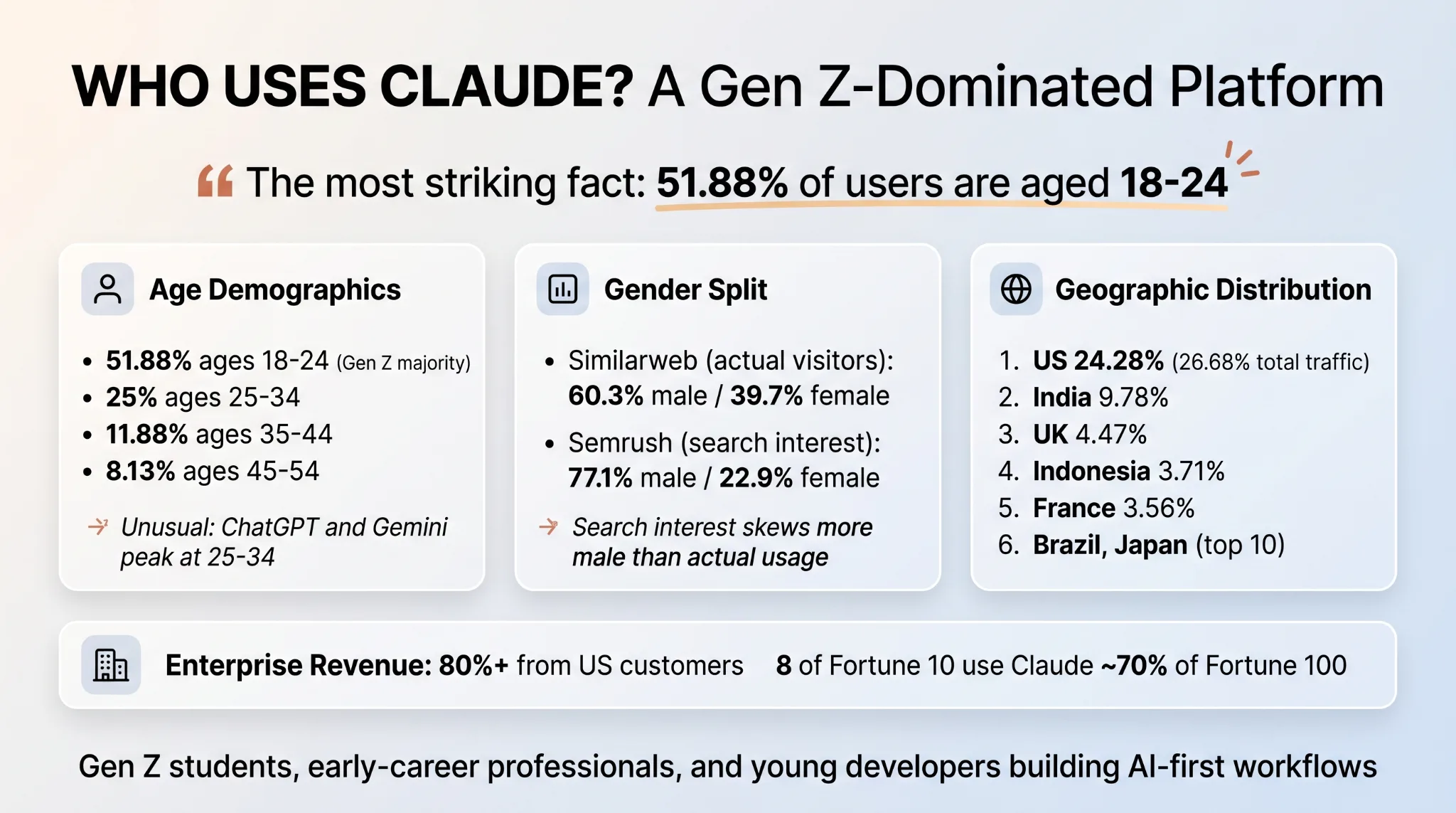
The single most striking demographic fact about Claude’s user base is this: 51.88% of users are aged 18 to 24. That means the majority of Claude’s audience is Gen Z. This is unusual even by AI industry standards — ChatGPT and Google Gemini both show the 25–34 age bracket as their largest demographic. Claude having more than half its base in the 18–24 range suggests the platform has resonated deeply with university students, early-career professionals, and younger developers who are building their workflows around AI from the ground up. The 25–34 group follows at 25%, with 35–44 at 11.88%, 45–54 at 8.13%, 55–64 at 2.21%, and users 65 and over accounting for 1.14%.
Gender Demographics
Estimates on gender split vary depending on methodology. Similarweb, which tracks actual website visitors, puts the split at 60.3% male and 39.7% female. Semrush, which measures search-driven interest, reports a wider gap at 77.1% male and 22.9% female. The discrepancy reflects the fact that search-driven interest in AI tools tends to skew more heavily male, while actual usage patterns are more balanced. Both figures indicate a male-majority user base, consistent with the broader AI developer and power-user communities.
Geographic Distribution
The United States is Claude’s dominant market, accounting for 24.28% of all web visits and approximately 26.68% of total global traffic. India ranks second at 9.78%, followed by the United Kingdom at 4.47%, Indonesia at 3.71%, France at 3.56%, with Brazil and Japan also in the top ten. In the enterprise context, the US dominance is even more pronounced — over 80% of Anthropic’s enterprise revenue comes from American customers, including eight of the Fortune 10 and approximately 70% of the entire Fortune 100.
Claude AI Revenue Statistics 2026
The Revenue Trajectory
The revenue story at Anthropic is without exaggeration one of the most dramatic in the history of enterprise software. Consider the trajectory:
2023: ~$10 million in annualized revenue (a company essentially just getting started)
End of 2024: ~$1 billion annualized run-rate, representing 567% growth
August 2025: ~$5 billion annualized run-rate
End of 2025: ~$9 billion annualized, representing roughly 800% growth on the prior year
February 2026: ~$14 billion annualized run-rate, confirmed by Anthropic in their Series G announcement
April 2026: Over $30 billion in annualized revenue
Late May 2026: Over $47 billion in annualized revenue, reported at the time of the Series H close
That jump from $9 billion to $47 billion in roughly six months is extraordinary by any measure. Analysts at SaaStr noted that Anthropic was growing revenue faster on a proportional basis than any enterprise software company in history. For the full year 2026, projections suggest Anthropic could reach approximately $26 billion in reported revenue (as opposed to run-rate), representing over 85% growth on 2025.
Enterprise Revenue Dominance
The revenue engine is overwhelmingly enterprise and API-driven. Approximately 80% of Anthropic’s total revenue is generated by enterprise customers and developers using the API on a pay-per-token basis. Over 300,000 business customers now use Claude, and more than 1,000 of them spend over $1 million per year — a figure that doubled from 500 in under two months. Two years ago, just a dozen customers hit the $1 million annual spend threshold. Today that number is well above 1,000 and growing. The number of customers spending over $100,000 per year has grown 7x year-on-year.
Claude Code Revenue
One of the most surprising sub-stories in Claude’s 2026 statistics is the rise of Claude Code. Launched to the general public in May 2025, Claude Code is Anthropic’s agentic coding tool — a product that lets developers delegate entire software tasks directly from their terminal. From nothing in early 2025, Claude Code has scaled to a $2.5 billion annualized run-rate by February 2026, more than doubling since January 2026 alone. By April 2026, analysts estimated that 4% of all public GitHub commits worldwide were being authored by Claude Code — double the percentage from just one month prior. Business subscriptions to Claude Code quadrupled from the start of 2026, and enterprise users now account for over half of all Claude Code revenue. Netflix, Spotify, KPMG, L’Oréal, and Salesforce are among the major companies deploying it in production.
Anthropic Funding and Valuation: The Numbers Behind the Numbers
From Startup to Near-Trillion
Anthropic’s funding history reads like a case study in exponential investor confidence. The company has moved from a $18.4 billion valuation in late 2023 to a $965 billion post-money valuation on May 28, 2026, when it closed its $65 billion Series H — arguably the largest single fundraising round in private market history, led by Altimeter Capital, Dragoneer, Greenoaks, and Sequoia Capital.
The key funding milestones look like this: The Series E (March 2025) raised $3.5 billion at a $61.5 billion valuation, with Lightspeed, Bessemer, and Salesforce Ventures leading. The Series F (September 2025) raised $13 billion at a $183 billion valuation, led by Sequoia Capital and Goldman Sachs. The Series G (February 12, 2026) raised $30 billion — a round originally targeted at $10 billion that was increased multiple times due to overwhelming investor demand — at a $380 billion post-money valuation, led by GIC and Coatue, with co-leads including D. E. Shaw, Dragoneer, Founders Fund, ICONIQ, and MGX. And then the Series H in late May 2026 at the staggering $965 billion valuation, with co-leads including Capital Group, Coatue, GIC, ICONIQ, and XN, plus participation from Blackstone, DST Global, Fidelity, General Catalyst, Jane Street, Lightspeed, Sequoia, Temasek, and T. Rowe Price, among dozens of others.
The Hyperscaler Bets
The funding story isn’t limited to traditional venture capital. The hyperscalers have made enormous strategic commitments to Anthropic. Google committed up to $40 billion in April 2026, with $10 billion deployed immediately and the balance tied to performance milestones, along with a commitment to deliver 5 gigawatts of compute capacity over five years. Amazon confirmed an additional $5 billion immediately with up to $20 billion more to follow, on top of the $8 billion it had previously invested. Anthropic has in turn committed over $100 billion in workloads to AWS over 10 years. Microsoft and NVIDIA joined the Series G as strategic investors. SpaceX entered an agreement to provide GPU capacity through its Colossus 1 and Colossus 2 infrastructure — the same compute platform built for xAI’s Grok. These aren’t passive financial bets — they represent deep infrastructure dependencies that bind Claude’s future to the world’s largest technology platforms.
Claude’s Model Family in 2026
The Current Lineup
Understanding Claude’s model family is essential for any content creator, developer, or enterprise buyer. The Claude 4 generation, launched in May 2025, represented a major architectural leap, and it has been followed by an aggressive release cadence in 2026 that has continued to push capabilities forward. The current active family includes:
Claude Opus 4.7 is the current flagship model, released April 16, 2026. It brings targeted coding upgrades, a new tokenizer, and significantly enhanced vision capabilities supporting images up to 2,576 pixels on the long edge (approximately 3.75 megapixels). It is the model of choice for the most demanding agentic, multi-step, and long-horizon tasks. It runs at a higher cost-per-token but delivers best-in-class performance for complex knowledge work.
Claude Sonnet 4.6, released February 17, 2026, is described as delivering Opus-level intelligence at a dramatically lower price point — approximately $3 per million input tokens and $15 per million output tokens. In developer evaluations, it was preferred over the previous Sonnet 4.5 roughly 70% of the time, and even over the prior-generation Opus 4.5 approximately 59% of the time. This is the model that has driven much of Claude’s developer adoption surge in early 2026, because it offers near-frontier capability at a price accessible to startups and individual developers alike.
Claude Haiku 4.5 is the speed and cost efficiency champion — designed for real-time applications, high-volume pipelines, and latency-sensitive integrations. It is the model powering Claude in Chrome, the browsing agent that operates directly within Google Chrome for users on Pro and Max plans.
Claude Opus 4.6, released February 5, 2026, introduced agentic team capabilities, Claude in PowerPoint, and a remarkable task-completion horizon — benchmarked at 14 hours and 30 minutes at 50% completion on METR’s long-horizon task evaluation, making it the most capable model tested at the time for sustained agentic work.
The Restricted Mythos Preview
One model deserves special mention. Claude Mythos Preview, released April 7, 2026, is the most capable model Anthropic has ever built — and it is not publicly available. Scoring 93.9% on SWE-bench Verified (the benchmark measuring ability to resolve real-world software engineering issues), it is being operated exclusively under “Project Glasswing,” a restricted partnership with nine organizations: AWS, Apple, Cisco, CrowdStrike, Google, JPMorgan Chase, Microsoft, NVIDIA, and Broadcom. Access is limited to defensive cybersecurity work only. Anthropic has stated that Mythos is capable of autonomously discovering zero-day vulnerabilities in major operating systems and browsers — which explains why it will not be released to the general public in its current form.
Looking Ahead: Claude 5 and Fable 5
Claude 5 is widely anticipated in the Q2–Q3 2026 window, with prediction markets pricing June 2026 as the most likely launch month (which aligns with the current date). Anthropic has also already announced Claude Fable 5 and Claude Mythos 5 as its next generation of models for the hardest knowledge work and coding problems, suggesting the release cadence will remain aggressive through the second half of the year.
Claude vs. The Competition: Market Share in 2026
Where Claude Stands Globally
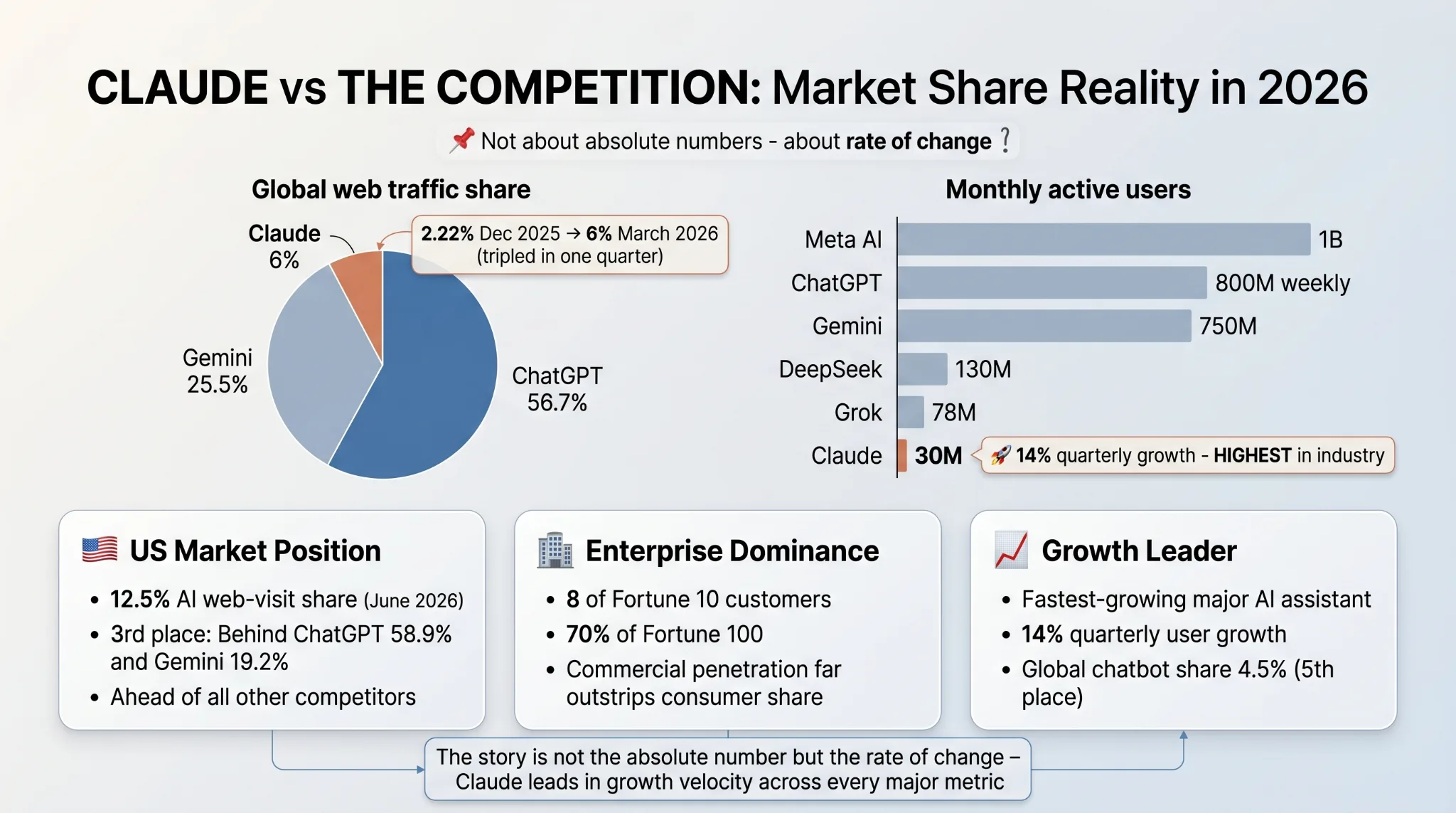
The competitive landscape in AI has shifted considerably, but it’s important to be honest about the numbers without over-spinning them. By global web traffic share as of March 2026, Claude holds approximately 6% of generative AI web traffic — up from just 2.22% in December 2025 (nearly tripling in a quarter) but still well behind ChatGPT at 56.7% and Google Gemini at 25.5%. By broader AI chatbot market share metrics, Claude sits at approximately 4.5% globally, ranking fifth behind ChatGPT (60.4%), Gemini (15.2%), Microsoft Copilot (12.9%), and Perplexity AI (5.8%).
By raw monthly active user count, the gap is even wider: Meta AI leads at 1 billion MAU, ChatGPT at 800 million weekly active users, Google Gemini at 750 million MAU, DeepSeek at approximately 130 million MAU, and Grok at approximately 78 million MAU — with Claude at approximately 30 million consumer MAU in mid-2026. However, the story here is not the absolute number but the rate of change. Claude is the fastest-growing major AI assistant by almost every metric tracked in 2026, having 14% quarterly user growth — the highest in the industry.
In the U.S. specifically, Claude has grabbed 12.5% of AI web-visit share as of June 2026, behind ChatGPT at 58.9% and Gemini at 19.2% but ahead of all other competitors. In the enterprise segment specifically, Claude has carved out a dominant position — with 8 of the Fortune 10 as customers and 70% of the Fortune 100, its commercial penetration among the world’s largest organizations far outstrips its consumer market share numbers.
What Every Content Creator Needs to Know About Claude in 2026
This is where statistics meet practical reality. Content creators — whether you are a blogger, copywriter, video scriptwriter, social media manager, newsletter author, or brand content strategist — need to understand what Claude specifically offers that affects your work.
Claude’s Strengths for Writing and Content Work
Claude has consistently earned a reputation among professional writers for producing content that reads more naturally than most AI-generated text. Its training through Constitutional AI and Reinforcement Learning from Human Feedback (RLHF) has resulted in outputs that are less robotic, more tonally aware, and better at maintaining stylistic consistency across long-form content. According to Anthropic’s Economic Index reports, approximately 15% of all Claude tasks fall into the Educational Instruction and Library category, reflecting strong usage for research, explanation, and structured content creation. Another 13% fall under Office and Administrative Support, which includes content drafting, editing, summarization, and document production.
The benchmark that matters most for content creators is that Claude completes college-level tasks 12 times faster than the human average, and high-school-level tasks 9 times faster. For content creators, this translates into dramatically accelerated first-draft generation, research synthesis, headline testing, and ideation workflows.
The Augmentation Model: Claude as a Creative Partner
A critical statistic for content creators to internalize is this: 52% of Claude conversations are classified as augmentation, and 45% as automation. Augmentation means collaborative, iterative work — back-and-forth refinement where a human and Claude treat each other as partners. Automation means one-shot task completion. The dominance of augmentation is not accidental; it reflects how the most productive Claude users actually work, and it aligns with how professional content creators should approach the tool.
The content creators getting the most value from Claude in 2026 are not the ones typing “write me a blog post about X” and publishing the output. They are the ones using Claude iteratively: generating a rough structure, critiquing it, exploring different angles, refining the tone, testing multiple hooks, building out research threads. Claude’s 200,000-token context window (and support for up to 300,000 output tokens beginning June 2026 on certain models) means it can hold an entire editorial strategy, a set of brand guidelines, previous drafts, and active tasks in a single session without losing track of what matters.
Subscription Tiers That Matter for Creators
Understanding Claude’s pricing is practical knowledge for content creators evaluating whether and how to subscribe. The Free tier gives access to Claude with limited message volume. Claude Pro at $20/month provides significantly more usage volume, priority access during peak times, access to more powerful models, and early access to new features — this is the entry point most individual content creators will evaluate. Claude Max comes in two tiers: Max 5x at $100/month for heavy users who regularly hit Pro limits, and Max 20x at $200/month for those doing all-day, high-intensity work. The Max plans also include access to Cowork, Anthropic’s agentic desktop app for Mac that lets Claude take actions across your computer, manage tasks, and work with files like a true digital collaborator. For teams, the Team plan provides collaborative workspace features with shared context. Enterprise pricing is custom, starting around $20 per seat per month with API usage billed separately.
For content creators specifically, the question of whether to upgrade from Free to Pro is easy: if you are using Claude daily for drafts, editing, research, or ideation, the Pro tier pays for itself quickly in time saved. If you are producing content at agency scale or using Claude Code to automate content pipelines, the Max tiers become relevant.
Claude for Specific Content Creator Use Cases
Several specific applications are worth highlighting for content creators in 2026. Claude’s strength in long-form research and synthesis makes it excellent for the background research phase of any article — feed it a topic, ask it to surface key angles, contradictions, and emerging perspectives, then use that as your editorial scaffolding. Its natural language handling means you can give it voice guidelines and it will maintain them more consistently than earlier model generations.
For SEO-oriented content creators, Claude’s ability to analyze search intent, generate semantic keyword clusters, draft meta descriptions, and write content structured around topical authority has made it a serious editorial tool. For video scriptwriters and podcast creators, Claude’s strength in multi-turn dialogue and its understanding of narrative pacing makes it unusually good at scripting — it thinks in structure, transitions, and audience engagement in a way that reflects its training on high-quality long-form text.
For newsletter creators and email marketers, Claude’s tonal consistency across large volumes of content is a key advantage. You can establish a voice in the first session, and Claude will maintain it across multiple drafts and content types without the tonal drift that affects shorter-context models.
The Claude Code Angle for Technical Content Creators
If your content creation work intersects with any technical subject matter — developer documentation, technical tutorials, code explainers, data journalism — Claude Code deserves a place in your toolkit. It is not just a code generator; it is a research and explanation tool that happens to be able to run and test what it writes. Technical content creators use it to generate reproducible examples, debug code snippets for tutorials, and verify that what they are writing about is actually accurate before it goes to publication.
The Strategic Context: Why Claude’s Growth Matters to Creators
There is one development in Claude’s 2026 story that content creators should pay attention to beyond the pure product features — the brand positioning moment that triggered Claude’s March 2026 mobile surge. In late February 2026, Anthropic publicly refused to remove contractual prohibitions on using Claude for mass domestic surveillance and fully-autonomous weapons systems, leading the U.S. Department of Defense to designate Anthropic a supply chain risk and begin phasing out federal use of Claude.
What happened next was unexpected. Rather than causing a user exodus, the news triggered an accelerated increase in consumer downloads. The Claude iOS app hit #1 in the U.S. App Store on February 28, 2026. Power user churn fell further. Claude’s reputation for being a “trustworthy” AI — built over years through its Constitutional AI approach and safety-first positioning — translated into tangible commercial momentum when it faced a genuine test of those values. For content creators, this matters because it says something real about the company building the tool you are considering making central to your workflow. It also contrasts sharply with some competitors’ choices.
Claude AI Statistics 2026: Summary of Key Numbers
To bring all of this together into a clear reference, here is a complete summary of the most important Claude statistics as of mid-2026:
Monthly Active Users (Consumer)≈30 million (mid-2026, up from 18.9M at start of year)
Monthly Active App Users≈7.38 million
Monthly Web Visits (May 2026)=952.6 million
Annualized Revenue (April 2026)=$30+ billion (reached $47B by May 2026)
Claude Code Run-Rate Revenue=$2.5 billion (February 2026)
Business Customers=300,000+ (with 1,000+ spending $1M+/year)
Anthropic Valuation (Series H, May 2026)=$965 billion
Total Funding Raised=$80+ billion
U.S. Mobile DAU Share (March 2026)=10% (up from <2% in December 2025)
Largest Age Demographic=18–24 at 51.88%
Fortune 100 Penetration≈70%
GitHub Commits via Claude Code=4% of all public commits worldwide
Closing Thoughts
Claude’s 2026 story is ultimately about a product that spent two years earning a reputation for quality, safety, and depth of capability among discerning users, and then experienced the kind of breakout growth that happens when a niche product crosses into mainstream consciousness. The statistics tell that story in numbers, but the underlying dynamic is one of trust being built, tested, and rewarded.
For content creators specifically, the message is straightforward: Claude is no longer the alternative AI you might try when you want something different from ChatGPT. It is a mature, full-featured, enterprise-grade creative and analytical partner with a pricing structure accessible to individuals, a model family that covers everything from budget-friendly quick drafts to deep long-horizon research, and a company behind it that has demonstrated both technical ambition and a genuine commitment to building AI that works in the long-term interest of its users.
The fastest-growing AI assistant in the market, serving 70% of the Fortune 100, approaching a trillion-dollar valuation, and spending 139 minutes a day with its most devoted users — Claude in 2026 is a tool that every serious content creator owes themselves the time to understand.
FAQs
Claude AI has grown significantly, with tens of millions of active users globally by 2026 across both individual and enterprise plans. Anthropic has reported substantial growth driven by API integrations and the Claude.ai consumer platform.
Anthropic is projected to surpass $1 billion in annualized revenue in 2026, largely fueled by enterprise API contracts and cloud partnerships with Amazon and Google. This marks a dramatic increase from its earlier growth stages.
Many content creators prefer Claude in 2026 for its longer context windows, nuanced writing style, and stronger instruction-following capabilities. However, the best choice depends on your specific workflow, as both tools have unique strengths.
By 2026, Anthropic offers several Claude models including Claude 3 variants and newer releases under the Claude 4 family, ranging from lightweight Haiku models to powerful Opus versions. Each tier is optimized for different speed, cost, and performance needs.
Understanding Claude AI's growth, user base, and capabilities helps content creators make smarter tool choices and stay competitive in an AI-driven market. Tracking these statistics also reveals emerging trends in how AI is reshaping content production workflows.